This is a continuation of an earlier article on two poems by Alfred Tennyson, Locksley Hall, and Locksley Hall - Sixty Years After. These are both fairly long poems, so consider my comments here more of a plot summary than an analysis.
http://theotherpages.org/poems/tenny02.html Locksley Hall
http://theotherpages.org/poems/tenny41.html Sixty Years After
The second poem takes place six decades later for the un-named hero (and about 45 years for Tennyson). Much has changed about the world, and about the narrator himself.
Some things stay the same. The bitter young man has turned into a bitter old man. Very bitter. Nothing in the present-day world brings pleasure to his eye, especially his grandson, who seems to be the object of much derision on the narrator's part. The grandson seems to be about the same age in this poem as the narrator was when he decided to leave home in the last poem. Or did he leave home? Perhaps he did, but something drew him back.
We learn that his beloved Amy, object of such anger at her betrayal in the first poem died in childbirth within a year of his leaving. He has nothing but fond memories of her now. We also hear that the man she married was not such a rat after all. In fact, in the end he praises the man:
Strove for sixty widow'd years to help his homelier brother men,
Served the poor, and built the cottage, raised the school, and drain'd the fen.
Hears he now the Voice that wrong'd him? who shall swear it cannot be?
Earth would never touch her worst, were one in fifty such as he.
We also learn of someone else, not mentioned in the first poem - Edith - met by chance when they were children - on the same day he met, and behaved rudely towards - the boy who would grow up to be Lord of Locksley Hall and Amy's future husband:
From that casement where the trailer mantles all the mouldering bricks--
I was then in early boyhood, Edith but a child of six--
While I shelter'd in this archway from a day of driving showers--
Peept the winsome face of Edith like a flower among the flowers.
And we learn that Edith, not Amy was his true soul-mate in life,
She with all the charm of woman, she with all the breadth of man,
Strong in will and rich in wisdom, Edith, loyal, lowly, sweet,
Feminine to her inmost heart, and feminine to her tender feet,
Very woman of very woman, nurse of ailing body and mind,
She that link'd again the broken chain that bound me to my kind.
So with his added sixty years of wisdom, many years of married happiness, and making peace with his memories of Amy and the man she married, why is he still so bitter? He himself admits,
Gone the fires of youth, the follies, furies, curses, passionate tears,
Gone like fires and floods and earthquakes of the planet's dawning years.
Fires that shook me once, but now to silent ashes fall'n away.
Cold upon the dead volcano sleeps the gleam of dying day.
The answer is two-fold. Part one of the answer is almost an Ubi Sunt sentiment (where have they gone, the great ones), except that he knows the answer - he has outlived his comrades, his loves, and his enemies. the word 'Gone' continues as a constant refrain:
Gone the tyrant of my youth, and mute below the chancel stones,
...
Gone the comrades of my bivouac, some in fight against the foe,
...
Gone with whom for forty years my life in golden sequence ran,
...
Gone our sailor son thy father, Leonard early lost at sea;
...
Gone thy tender-natured mother, wearying to be left alone,
Pining for the stronger heart that once had beat beside her own.
From this we also learn that he outlived his only child, his son Leonard, who died a hero, long ago, a loss that weighs heavily upon him:
Beautiful was death in him who saw the death but kept the deck,
Saving women and their babes, and sinking with the sinking wreck,
In fact he has outlived the world he knew - everything and everyone in it. All that is left to him is his grandson -
Thou alone, my boy, of Amy's kin and mine art left to me.
This is an impossible burden for anyone - to make up for the loss of an entire world - the bar for his affections has been set too high - he can only disappoint. Even the thing that should bring them together - that the grandson is spurned by the woman he asks to be his wife - becomes the source for more derision:
So--your happy suit was blasted--she the faultless, the divine;
And you liken--boyish babble--this boy-love of yours with mine.
Part two of the answer, the reason for his bitterness, is that one of his repeated refrains from the first poem, 'Forward' now haunts him - change, the march of progress, his visions of the future:
Gone the cry of 'Forward, Forward,' lost within a growing gloom;
Lost, or only heard in silence from the silence of a tomb.
Half the marvels of my morning, triumphs over time and space,
Staled by frequence, shrunk by usage into commonest commonplace!
'Forward' rang the voices then, and of the many mine was one.
Let us hush this cry of 'Forward' till ten thousand years have gone.
The narrator goes into a ranting monologue of over 200 lines, decrying the devolution of everything - religion, politics, animal cruelty, class equality, foreign policy, the aristocracy's arrogant ignorance, and of course those who prey upon, and nurture that ignorance:
You that woo the Voices--tell them 'old experience is a fool,'
Teach your flatter'd kings that only those who cannot read can rule.
...
Here and there a cotter's babe is royal-born by right divine;
Here and there my lord is lower than his oxen or his swine.
Rising industrialization, and the changes it has brought about in society are also a source of his bitterness. He that called for progress now observes exploitation and devolution wherever he looks:
Is it well that while we range with Science, glorying in the Time,
City children soak and blacken soul and sense in city slime?
There among the glooming alleys Progress halts on palsied feet,
Crime and hunger cast our maidens by the thousand on the street.
There the Master scrimps his haggard sempstress of her daily bread,
There a single sordid attic holds the living and the dead.
There the smouldering fire of fever creeps across the rotted floor,
And the crowded couch of incest in the warrens of the poor.
Perhaps Bob or Howard could say for certain, but I would wager this is the most scathing piece ever written by a Poet Laureate during his tenure.
There are some lines again, in this poem, that do not play well to modern ears. Some lines of ignorance and prejudice that I don't think have parallels in Tennyson's other works and really do not add anything constructive to the metaphors for time and eternity that eventually segue into his bitter rant.
The poem is a re-visitation, some might say a revisionist view of the original story, and while it answers many questions it also introduces some contradictions. The meter, which works so well for the first poem seems more forced here. And ultimately, it is a sad poem. The bitterness is mixed with loss and regret, and always there is the realization that the narrator's time on earth (and the poet's time as well) is growing short.
This poem does bring the story full-circle. In the end we learn that the occasion for their rendezvous at Locksley hall is the death of Amy's husband, whose funeral they will attend tomorrow, and that the narrator's grandson, the last surviving member of the family, will himself become Lord of the manor - a surprise and very ironic ending to such a long piece:
Forward, let the stormy moment fly and mingle with the Past.
I that loathed, have come to love him. Love will conquer at the last.
Gone at eighty, mine own age, and I and you will bear the pall;
Then I leave thee Lord and Master, latest Lord of Locksley Hall.
 The Digital Painting collection has been updated with 10 new images. All images are available in 1024 and 2028 pixel widths/lengths.
  You may know that the most famous writer of short stories in American literature was a gentleman named O Henry, who wrote great volumes of stories and poems while living in a microscopic stone house in the midst of what is now a parking lot in San Antonio, Texas. We'll save O Henry for another time. Today's article is on Joyce Carol Oates -- a very recognizable and very prolific figure in American literature. She is an author, poet, teacher, editor and publisher, a runner a diarist, and an essayist.
 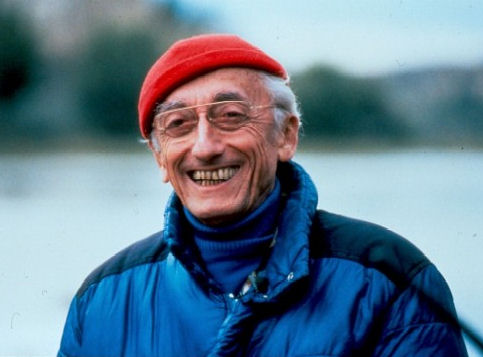 June 11th marks the 100th anniversary of the birth of Jacques-Yves Cousteau, one of the greatest explorers the world has ever known. Cousteau was a French naval officer who excelled at diving. After World War II, he turned his passion into a career, then turned his career into a cause. Eventually he became a touchstone for our awareness of the world around us. Cousteau gave us his first-person observations of "beauty and fragility" of the undersea world, and of the living world as a whole. The Cousteau Society, with several hundred thousand members, lives on in his name, promoting the need to address environmental issues and act as responsible stewards of underwater ecosystems.

